Build a Trade in Five Questions
- Name the role, position, contract, or blocked development path before searching for a player.
- Compare the deal with an internal promotion, role change, Free Agency, or waiting for the draft.
- Separate true surplus from depth that only looks expendable while the club is healthy.
- A contender, retooling club, and rebuild should value the same player differently.
- Recheck the depth chart, playing-time routes, contracts, and Team Chemistry before confirming.
Trades: Overview
Trades reshape the roster without waiting for the Draft or Free Agency. They can solve an immediate weakness, clear a blocked development path, exchange surplus depth, or move a contract that no longer fits the club. Every deal should answer a specific roster question on both sides of the transaction.
What Trades Are For
- Address an immediate positional weakness
- Acquire younger talent for a long-term plan
- Exchange a veteran whose role or contract no longer fits
- Rebalance depth between the first team and farm system
Which Roster Tool Fits the Problem?
| Need | First option to check | Why |
|---|---|---|
| A short injury absence | Internal depth | A permanent cost may be unnecessary. |
| A prospect needs a clear role | Promotion or trade | The solution should create playing time, not another blockage. |
| A contender has one obvious weakness | Targeted trade | Immediate value may justify surrendering surplus or future value. |
| A long-term core piece is missing | Draft, development, or selective acquisition | Do not force an expensive short-term answer into a long-term job. |
How Trades Differ from Free Agency
A trade is a direct negotiation between organizations: both roster construction and the value moving in each direction matter. Free Agency is primarily a contract and compensation process.
Relationship with Team Chemistry
Trades can affect Team Chemistry as well as talent. Moving a player changes roles, opportunities, and how the remaining roster views its place in the organization. Check the depth chart and Chemistry risk after the deal—not only the ratings exchanged.
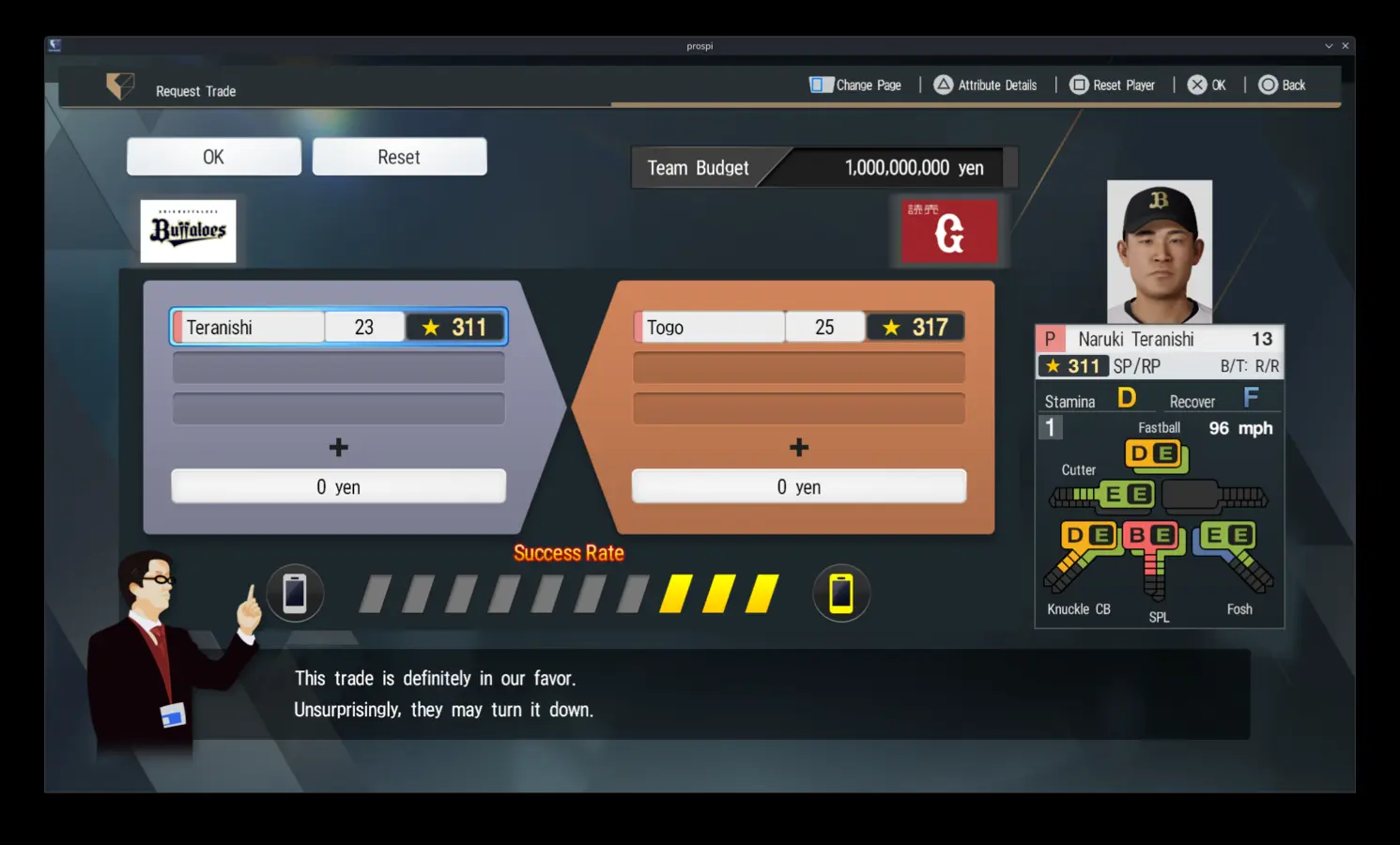
Trade Advice and Estimated Success
| Advice summary | Success rate |
|---|---|
| Trade should succeed; no roster problem expected | 100% |
| Trade should succeed; terms favor the other club | 100% |
| Benefits both clubs; very good trade | 100% |
| Slightly favors us; likely to succeed | 80–99% |
| Slightly favors them; may be rejected | 60–79% |
| Clearly favors us; rejection would be unsurprising | 30–59% |
| Obviously favors us; rejection likely | Below 30% |
| Would make the other club's roster construction difficult | 0% |
| Would clearly break our roster construction | 0% |
A High Success Estimate Is Not a Value Verdict
The gauge and adviser assessment estimate whether the proposal may be accepted. They do not prove that the exchange improves your roster, budget, or development paths.
- Judge acceptance and value separately.
- Recheck the outgoing role before submitting.
Before You Confirm
- Open the depth chart and identify who inherits every vacated role.
- Check whether the outgoing player is genuine surplus at both the top team and farm level.
- Compare the contract and roster timeline on both sides.
- Review Team Chemistry and the development paths changed by the move.
The Repeatable Plan
- Start with a roster problem, not with a famous target.
- Use trades when both the cost and the timing fit the organization.
- Recheck depth, Chemistry, contracts, and playing time before confirming.