The Budget Decision Loop
- Check what the club can actually spend before treating a roster idea as a plan.
- Account for the players, staff, scouting, and offseason work the organization cannot afford to lose.
- Spend on the weakness that changes the club most instead of improving several minor areas at once.
- Leave room for injuries, contract decisions, draft activity, and opportunities that appear later.
What Team Funds Actually Control
Team funds are the club’s room to act. They connect attendance and organizational success to salaries, staff, scouting, contracts, trades, and other roster operations. A large balance is useful only when it is converted into decisions that support the current team and the next one.
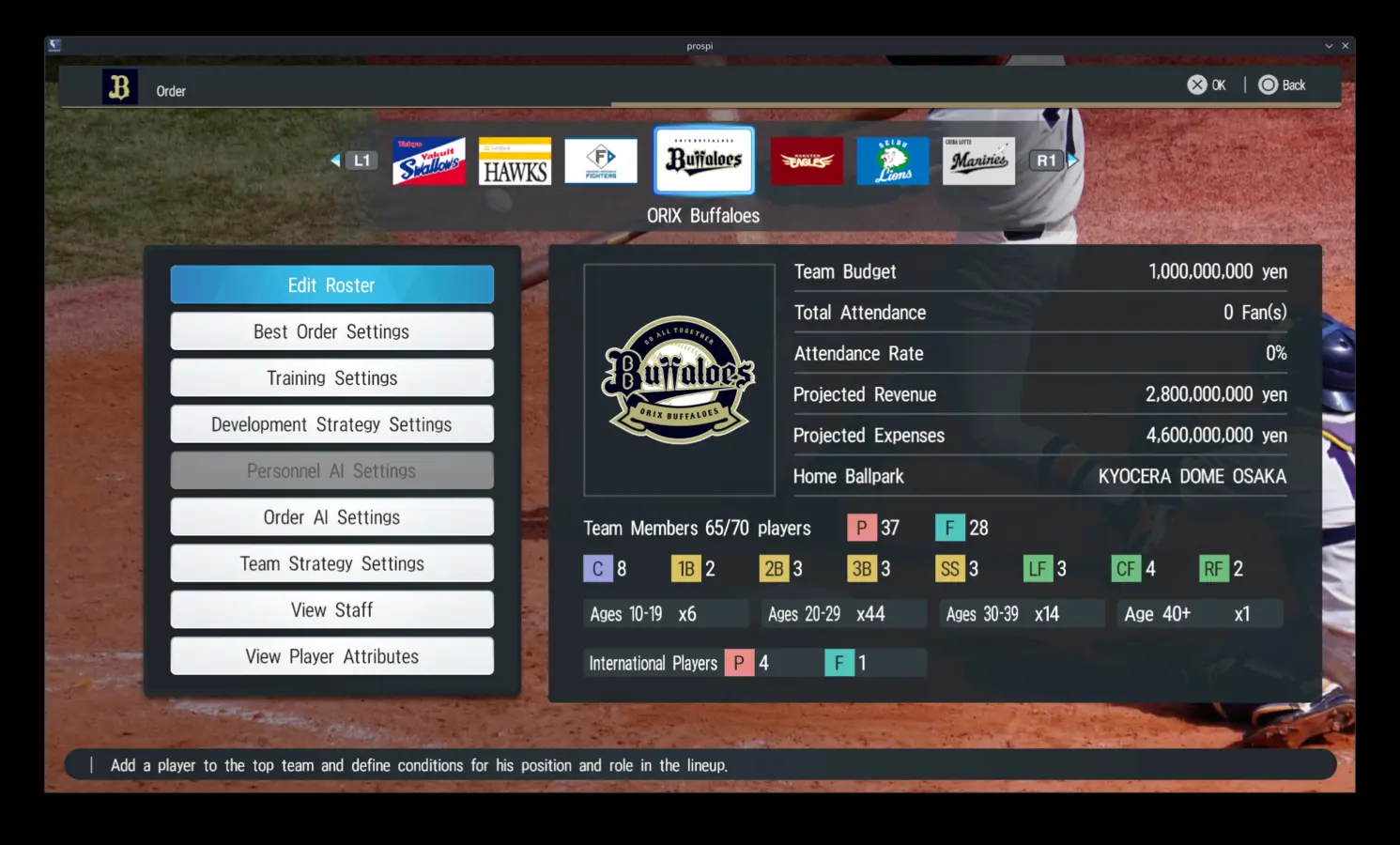
Finance overview
Read the Whole Budget Before Spending
The team overview combines current budget, roster composition, and projected finances. A player can be affordable in isolation while still making the remaining offseason impossible.
- Reserve money for renewals and unresolved vacancies.
- Treat projected income as context, not cash already available.
Spend, Save, or Rebalance?
| Situation | Best response | Reason |
|---|---|---|
| A clear weakness blocks a competitive team | Spend selectively | One targeted upgrade can change the season. |
| The roster has several aging contracts | Keep a reserve | Future renewals and replacements matter more than a marginal upgrade. |
| A prospect is ready but blocked | Rebalance the roster | A trade or role change may solve the problem without adding payroll. |
| The club is rebuilding | Invest in durable value | Scouting, development paths, and controllable talent support more than one season. |
The Club-Finance Loop
| Step | Relationship |
|---|---|
| 1. Team performance | Winning and fan interest support attendance. |
| 2. Attendance | Stronger crowds increase expected annual income. |
| 3. Team funds | The club gains more room for salaries, scouting, contracts, trades, and draft operations. |
| 4. Investment | Better roster and staff decisions can improve future performance. |
Team-Fund Income Growth
Estimated annual income by club fund level and average attendance.
- 70% attendance: 1, 1.4, 1.6, 2, 2.2, 2.4, 2.6
- 80% attendance: 1.2, 1.6, 2, 2.6, 3.2, 3.8, 4.4
- 90% attendance: 1.8, 2.6, 3.2, 4.6, 6, 7.4, 8.8
- 100% attendance: 2.8, 4, 5.4, 7, 9, 11, 13
Vertical values are billions of yen. These are legacy-reference estimates.
Table example
What Ten Attendance Points Mean at Fund Level 4
Compare two cells in the same legacy-reference row.
Example inputs
- Fund Level 4 at 80% attendance: ¥2.6B estimated annual income.
- Fund Level 4 at 90% attendance: ¥4.6B estimated annual income.
- 1
Income difference: ¥4.6B − ¥2.6B = ¥2.0B. - 2
Relative increase: ¥2.0B ÷ ¥2.6B ≈ 76.9%.
What this showsIn this reference model, moving from 80% to 90% attendance at Fund Level 4 corresponds to roughly ¥2.0B more estimated annual income.
Legacy-reference estimate, not a guaranteed 2026 payout formula.
Estimated Annual Team-Fund Income
| Fund level | 70% attendance | 80% | 90% | 100% |
|---|---|---|---|---|
| 1 | ¥1.0B | ¥1.2B | ¥1.8B | ¥2.8B |
| 2 | ¥1.4B | ¥1.6B | ¥2.6B | ¥4.0B |
| 3 | ¥1.6B | ¥2.0B | ¥3.2B | ¥5.4B |
| 4 | ¥2.0B | ¥2.6B | ¥4.6B | ¥7.0B |
| 5 | ¥2.2B | ¥3.2B | ¥6.0B | ¥9.0B |
| 6 | ¥2.4B | ¥3.8B | ¥7.4B | ¥11.0B |
| 7 | ¥2.6B | ¥4.4B | ¥8.8B | ¥13.0B |
A Simple Budget Rule for Beginners
- Fund the club’s essential operations before optional upgrades.
- Judge contracts by the role and years they occupy, not only the current rating.
- Keep enough flexibility to respond during the season and offseason.
- Review the budget after every large roster commitment.
The Repeatable Plan
- Connect every expense to a specific competitive or long-term need.
- Preserve a reserve instead of using the full balance as a spending target.
- Use attendance estimates as context, not as a promise of exact income.