Manage Chemistry Through Clear Roles
- Starter, rotation player, specialist, depth, or development assignment.
- Make playing time and roster treatment consistent with that role.
- Salary changes and negotiations can alter the player’s relationship with the club.
- Use chemistry values as evidence that a role or treatment problem may exist.
- Adjust opportunity, role clarity, contract handling, or roster fit—not the number alone.
A Strong Team Still Needs Clear Player Roles
Team Chemistry reflects each player’s relationship with the club. Winning does not automatically solve unclear playing time, contract treatment, or a roster role that no longer matches expectations.
- Takumi defines the practical role and opportunity.
- Sato checks the chemistry signal, thresholds, and likely cause.
- The response should address the player relationship, not merely chase a higher number.
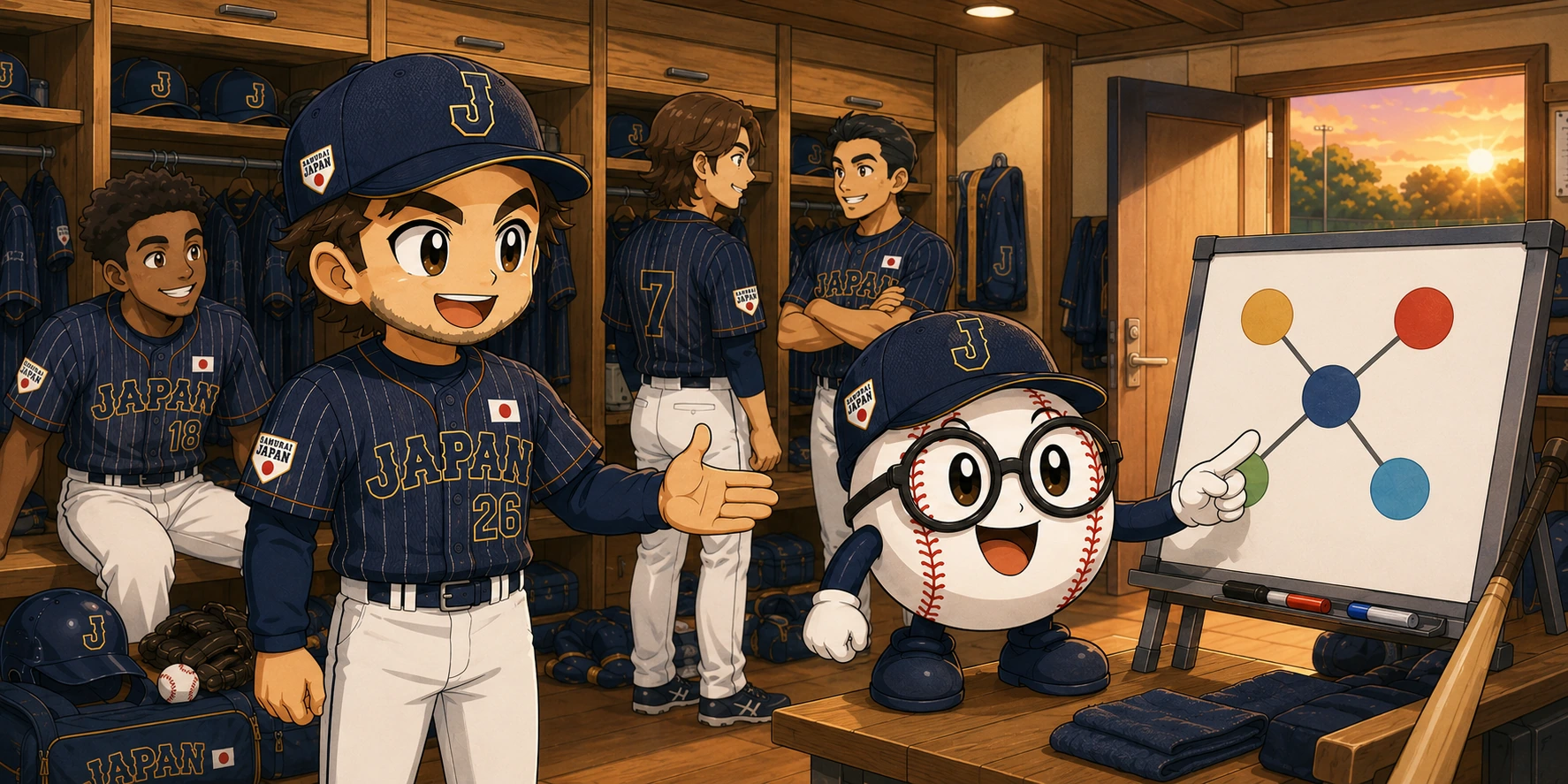
Team Chemistry Is the Player's Relationship with the Club
Team Chemistry measures how securely a player is connected to your organization. It is not the same as the face icon shown for current Condition, and it is not a simple reflection of wins and losses. A strong club can still have a player with low Chemistry when that player receives little opportunity, dislikes the contract outcome, or is repeatedly displaced by roster decisions. The current release calls the mechanic Team Chemistry. Older official guides call it Team Love (チーム愛), so both names remain useful search terms.
What Changes Team Chemistry?
| Management signal | Likely direction | What it means in practice |
|---|---|---|
| Appearing in first-team games | Increase | Regular opportunities strengthen the player's connection with the club |
| Long periods without playing | Decrease | A bench role still needs purposeful appearances and a believable job |
| Remaining on the farm team | Gradual decrease | Do not store established players there indefinitely without a plan |
| Salary and contract decisions | Increase or decrease | The result is judged against the player's expectations, not only the club budget |
| Trades, releases, and roster treatment | Context-dependent | A transaction can affect more than the player directly involved |
| Stable, appropriate role | Protective | Clear use is safer than constantly moving a player between jobs |
Individual event values can vary; use the direction of change to diagnose the roster decision behind it.
Manage Chemistry by Roster Role
| Player situation | Good management response | Warning sign |
|---|---|---|
| Everyday starter | Keep the role stable and monitor fatigue before forced absences accumulate | Repeated unexplained demotions or contract conflict |
| Platoon or specialist | Use the player in the matchups and situations that justify the roster spot | Weeks pass without a start, substitution, or defined purpose |
| Young reserve | Balance first-team exposure with the development value of regular farm playing time | The player occupies a bench seat without development or appearances |
| Established player on the farm | Create a promotion route, trade route, or honest roster decision | The assignment becomes permanent storage |
| Veteran losing a role | Reduce the role deliberately and prepare a replacement rather than changing direction every week | The player loses time, salary satisfaction, and organizational value together |
Chemistry Can Shape Condition and Slumps
Team Chemistry is a longer-term organizational state; the face icon is current Condition. They are separate, but they interact. High Chemistry makes bad-condition and Slump periods easier to manage, while very low Chemistry can restrict how high Condition may rise. When several players show blue faces, do not assume Chemistry is the only cause. Check fatigue, schedule, health, recent performance, and Slump status as well. Use the dedicated Player Condition Faces article for the immediate start, rest, rotate, or item decision.
Team Chemistry Reference Bands
| Value | Documented 2021 effect | How to use it in 2026 |
|---|---|---|
| 100 | Player will not declare Free Agency | Current help confirms 100 as the maximum; treat the exact FA protection as inherited until retested |
| 90–99 | Lower FA risk; bad-condition and Slump periods become shorter | Useful high-Chemistry target, with exact thresholds inherited from 2021 |
| 60–89 | No special threshold effect | Stable middle range in the older official model |
| 40–59 | Bad-condition periods become longer; certain long-serving players face greater FA risk | Warning range in the inherited model |
| 39 or lower | Condition cannot rise above Good | Critical low-Chemistry warning; exact cutoff remains legacy-labelled |
The numerical bands are retained from the 2021 model because the current help does not display every cutoff.
Salary-Change Reference Formula
| Contract outcome | Documented 2021 calculation | Manager meaning |
|---|---|---|
| Salary increase | Raise percentage × 20 × 0.01 | A meaningful raise can improve Chemistry |
| Salary decrease | Reduction percentage × 40 × 0.01 | Cuts carry a stronger negative weight than equivalent raises |
| Very large percentage change | Percentage is capped at 300% for the calculation | Extreme contract changes do not scale without limit |
| Salary below request; Chemistry 30 or lower | Additional −6 | An already unhappy player reacts more strongly |
| Salary below request; Chemistry 60 or lower | Additional −4 | Contract dissatisfaction can push a vulnerable player lower |
| Multiple players released together | Remaining players' Chemistry is halved | Mass releases can create an organization-wide shock |
These calculation values come from the 2021 model; use them as planning guidance where the current interface does not expose the calculation.
Why a Salary Cut Weighs More Than the Same Raise
Compare equal percentage changes using the documented 2021 Chemistry model.
- Salary increase: percentage × 20 × 0.01.
- Salary decrease: percentage × 40 × 0.01.
- Example change: 25%.
- 1
25% raise: 25 × 20 × 0.01 = 5 positive Chemistry units. - 2
25% cut: 25 × 40 × 0.01 = 10 negative Chemistry units. - 3
Magnitude comparison: 10 ÷ 5 = 2.
Documented 2021 model. Use it as planning guidance unless the current 2026 interface exposes a changed calculation.
Takumi's Weekly Chemistry Check
- Identify anyone occupying a roster spot without starts, substitutions, defensive work, or matchup use.
- Separate developing prospects from established players who are simply blocked.
- Do not mistake a temporary blue face for a Chemistry diagnosis.
- A role problem becomes more expensive when salary expectations or service time also become urgent.
- Schedule an appearance, redefine a role, promote, demote, trade, or negotiate—do not churn the whole roster.
Problem, Cause, and Best First Response
| Visible problem | Check first | Best first response |
|---|---|---|
| Bench player's Chemistry is falling | Actual appearances and role clarity | Create meaningful use or reconsider the roster spot |
| Established player is stuck on the farm | Promotion path and positional blockage | Promote, trade, or make a deliberate long-term decision |
| Several players have poor Condition | Fatigue, schedule, Chemistry, and Slump status | Diagnose the shared cause before changing the lineup |
| Veteran may declare FA | Chemistry, playing time, salary, service context | Address the relationship before negotiations become the only remaining lever |
| Prospect is not playing | Development need versus first-team exposure | Choose regular farm development or purposeful first-team opportunities |
| Budget requires salary cuts | Who carries low Chemistry or role frustration already | Avoid stacking a severe cut onto an unresolved role problem |