The Practical Route
- Define the lineup, rotation, bullpen, bench, or depth job.
- Check growth phase, prime, decline, and Growth Type.
- Use Ability Type to understand which attribute groups develop efficiently.
- Prioritize the attributes that make the future role playable.
- Connect strategy, training, coaching, and opportunity.
Player Development Overview
Learn the complete development loop before opening individual growth, training, experience, trait, and ceiling systems.
The Development Loop
- Define the lineup, rotation, bullpen, bench, or depth job the player should eventually fill.
- Growth, prime, and decline determine how much time and return the plan can expect.
- Align Development Strategy, training, coaching, and competition level with the role.
- Use meaningful playing time and achievable record situations to turn preparation into experience.
- Check growth, traits, ability changes, and roster fit before continuing or changing the plan.
Develop the Player the Roster Will Need
A development plan becomes clearer when it begins with a baseball role rather than a rating you want to increase. Compare position, age, growth stage, current tools, and the opening that may exist when the player is ready.
- Name the future job.
- Identify the few tools that make that job usable.
- Choose training and opportunities that support those tools.

3.1 Introduction
Player Development is the central simulation system of Pennant Mode. Progress does not come from one experience bar or one overall rating. Career timing, hidden tendencies, training direction, coaching, match participation, production, and long-term roster decisions all contribute separately. Two players who begin with similar ratings can therefore follow very different careers. One may receive the right role during a strong growth window; another may lose opportunities, train toward the wrong profile, or decline before the organization prepares a replacement. The manager's job is to align timing, role, training, and playing time.
How Player Development Is Built
| Layer | Systems | What it answers |
|---|---|---|
| Career timing | Growth Period and Growth Type | When does the player improve, peak, and decline? |
| Player profile | Ability Type and Player Traits | Which abilities develop most naturally? |
| Manager input | Development Strategy, Training, and coaching | Where should the club direct development work? |
| Game opportunity | Match Experience and Record Experience | How does real playing time reinforce development? |
| Ability change | Ability Changes, Awakening, and Limit Break | Which exceptional events can alter the normal career path? |
How to Read the Model
Start with career timing, then identify the player profile, choose an appropriate development direction, and finally provide training and game opportunities. Awakening and Limit Break are exceptional outcomes layered on top of that normal process.
Growth Period
Use the growth, prime, and decline stages to time investment and succession decisions.
Read the Curve With the Labels Above It
Growth Period tells you where the player is now; Growth Type describes the shape of the career; Ability Type identifies which attributes improve most easily. The graph is evidence of the profile, not a promise of exact future ratings.
- Read the labels before interpreting the line.
- Use age and roster opportunity together with the curve.
- Do not confuse a favorable curve with guaranteed playing time.
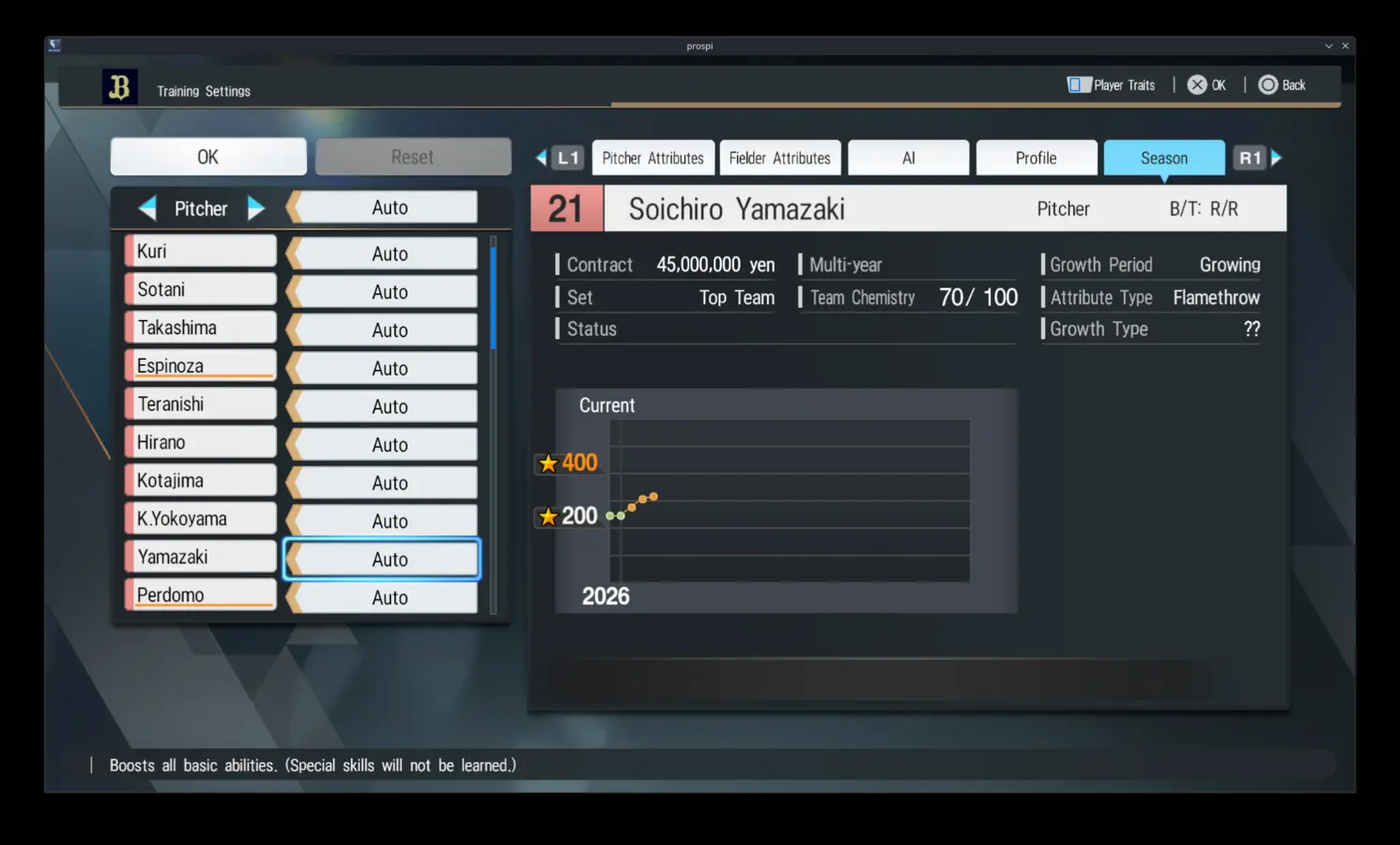
Read the Career Curve Before Investing
- Prioritize development time, training support, and a route to meaningful experience.
- Use the player’s completed tools in the role that gives the club the most value.
- Reduce assumptions based on past ratings and prepare the successor before the role becomes vacant.
The Three Career Phases
| Phase | Typical development | Manager response |
|---|---|---|
| Growth | The largest attribute gains; training and match experience have the greatest long-term value. | Invest playing time, coaching, and targeted training. |
| Prime | Growth slows while performance is usually at or near its peak. | Compete now while preparing the next player in the depth chart. |
| Decline | Attributes begin to decrease over time. | Reduce unnecessary workload, use training settings to soften decline, and plan succession. |
Managing the Decline Phase
Training Settings can reduce the rate of attribute loss during the Decline phase. They do not remove decline, but they give the manager some control over how quickly it progresses. Use that time to preserve a veteran's role while preparing the next player in the depth chart.
Growth Type and Ability Type
Keep career-curve information separate from the player's baseball archetype.
Read the Two Systems in Order
- Ask when the player is expected to grow, peak, and decline.
- Ask which groups of baseball attributes are easier for that player to develop.
- Decide which of those possible gains actually matter to the future job.
- Use the timing and attribute tendency together without treating either as destiny.
Growth Type and Ability Type: Definition
Growth Type describes the shape of a player's full career curve: when improvement is strongest, when it slows, and when decline begins. It is separate from Growth Period, which describes the player's current stage within that career.
Do Not Confuse These Systems
| System | Question | Practical use |
|---|---|---|
| Growth Period | Where is the player in his career right now? | Decide whether to invest, compete, or prepare a replacement. |
| Growth Type | What shape does the player's full career curve follow? | Estimate when strong growth and decline are likely. |
| Ability Type | Which attributes grow most naturally? | Choose a role and training direction that fit the player. |
| Development Strategy | Which role is the club actively building toward? | Direct training toward the intended roster job. |
Official Growth Types
Six growth patterns are used: Early, Normal, Late, Super-late, Extreme, and Two-stage. The graph below makes their timing easier to compare. Treat the curve as a planning signal rather than a promise that every player will gain the same attributes at the same age.
Growth Type and Ability Type: Definition
Ability Type determines which areas of a player's abilities receive the greatest emphasis during development. Unlike Growth Type, Ability Type does not determine career timing. Instead, it influences attribute specialization.
From Profile to Result
| Step | Information | Decision |
|---|---|---|
| 1 | Growth Period and Growth Type | Judge the player's timing and remaining development window. |
| 2 | Ability Type | Identify the attributes that are easiest to develop. |
| 3 | Development Strategy | Choose the role the organization wants the player to fill. |
| 4 | Training and playing time | Supply repeated opportunities that support that role. |
| 5 | Result | Review the complete profile and adjust rather than reacting to one rating. |
Growth Curves by Player Age
Compare when each growth type peaks and begins to decline.
- Early: 4, 4, 4, 4, 3, 2, 0, -1, -1, -2, -3, -3, -3, -3
- Normal: 3, 3, 4, 4, 4, 4, 2, 0, 0, -1, -2, -3, -3, -3
- Late: 2, 2, 3, 4, 4, 4, 4, 2, 0, 0, -1, -2, -3, -3
- Super-late: 2, 2, 2, 3, 4, 4, 4, 4, 2, 0, 0, -1, -2, -3
- Extreme: 3, 3, 4, 4, 4, 4, 0, 0, 0, -2, -3, -3, -3, -3
- Two-stage: 4, 4, 4, 4, 3, 2, 3, 0, 0, -1, -2, -3, -3, -3
Higher values indicate stronger growth. Zero is neutral; negative values represent decline.
Early and Late Growth at Two Career Checkpoints
Use the curve to compare timing before you interpret individual rating changes.
- Age 20: Early modifier 4; Late modifier 2.
- Age 30: Early modifier 0; Late modifier 4.
- 1
Age 20 difference: 4 − 2 = 2 modifier levels in favor of Early growth. - 2
Age 30 difference: 4 − 0 = 4 modifier levels in favor of Late growth.
The example reads the documented curve without inventing an undocumented modifier-to-attribute formula.
Ability Type: Attributes That Grow Most Easily
| Player | Ability type | Favored attributes |
|---|---|---|
| Pitcher | Authentic | Stamina |
| Pitcher | Power pitcher | Velocity and pitch quality |
| Pitcher | Breaking-ball pitcher | Pitch quality and break |
| Pitcher | Control pitcher | Control |
| Fielder | All-rounder | Balanced growth across all attributes |
| Fielder | Contact | Contact vs RHP, contact vs LHP, power |
| Fielder | Power | Power |
| Fielder | Hitting | Contact vs RHP, contact vs LHP, power |
| Fielder | Speed | Speed |
| Fielder | Defense | Arm strength, fielding, throwing, positional aptitude |
| Fielder | Agile offense | Contact vs RHP, contact vs LHP, speed |
| Fielder | Agile defense | Speed and positional aptitude |
Growth Type by Age — Official Growth Modifier
| Type | 18 | 20 | 22 | 24 | 26 | 28 | 30 | 32 | 34 | 36 | 38 | 40 | 42 | 45 |
|---|---|---|---|---|---|---|---|---|---|---|---|---|---|---|
| Early | 4 | 4 | 4 | 4 | 3 | 2 | 0 | −1 | −1 | −2 | −3 | −3 | −3 | −3 |
| Normal | 3 | 3 | 4 | 4 | 4 | 4 | 2 | 0 | 0 | −1 | −2 | −3 | −3 | −3 |
| Late | 2 | 2 | 3 | 4 | 4 | 4 | 4 | 2 | 0 | 0 | −1 | −2 | −3 | −3 |
| Super-late | 2 | 2 | 2 | 3 | 4 | 4 | 4 | 4 | 2 | 0 | 0 | −1 | −2 | −3 |
| Extreme | 3 | 3 | 4 | 4 | 4 | 4 | 0 | 0 | 0 | −2 | −3 | −3 | −3 | −3 |
| Two-stage | 4 | 4 | 4 | 4 | 3 | 2 | 3 | 0 | 0 | −1 | −2 | −3 | −3 | −3 |
The Repeatable Plan
- Growth Type answers when; Ability Type answers what grows easily.
- An easy gain is not automatically a useful gain.
- Development investment should serve a believable future role.