The Practical Route
- Acquire and develop the next competitive core.
- Use budget and depth to support the current window.
- Introduce successors while veterans can still carry responsibility.
- Record the players, eras, and standards that define the franchise.
- Carry the strongest organizational practices into the next generation.
Unlimited Seasons and Save History
Plan for a franchise that can continue indefinitely while preserving its recent historical record.
Unlimited Play Turns Succession into a Permanent Job
A long save no longer approaches a fixed final season. Every championship core eventually ages, every staff group changes, and every prospect class must either become useful or be replaced by the next one. This changes the meaning of rebuilding. Succession is not a special recovery phase used once after the original roster disappears; it is a routine that continues while the team is still competitive.
Build Standards That Survive Generations
| Standard | What to preserve | Why it matters |
|---|---|---|
| Drafting | A repeatable priority for premium positions and organizational weaknesses | One weak class should not erase the pipeline |
| Development | Clear playing-time and training routes | Prospects need a path, not only potential |
| Staff succession | Future coaches and managers before vacancies become urgent | Player growth should not collapse with one retirement |
| Financial discipline | Room for renewals and targeted acquisitions | One competitive window should not consume the next one |
| Historical identity | Hall of Fame, records, and memorable eras | The visible history window is limited even when the save is not |
The Repeating Dynasty Cycle
- Acquire and develop the core.
- Use budget and depth to support the competitive window.
- Introduce replacements before decline removes every option at once.
- Carry the strongest standards into the next generation rather than rebuilding from zero.
Legacy Players and Hall of Fame
Use historical players and archives without losing the identity created by the current save.
Legacy Player Lifecycle
| Stage | How it works |
|---|---|
| Configuration | Choose whether Legacy Players appear and how many enter the save. |
| Acquisition | They can enter through the Rookie Draft or international scouting. |
| Development | They continue developing through the normal club environment, opportunities, and performance systems. |
| Career archive | Statistics, awards, Hall of Fame evaluation, and statue management preserve the completed career. |
Historical Comparison
2019 No equivalent system documented. 2021 No equivalent system documented. 2026 Legacy Players introduced.
Statue Lock
One new feature introduced in 2026 allows managers to lock Hall of Fame statues. Locked statues remain permanently preserved within the archive. This prevents important franchise history from being overwritten during extremely long Pennant saves.
Organizational Role
The Hall of Fame performs more than a commemorative function. It documents the complete history of the organization. Long-term franchises therefore develop their own historical identity over many decades.
Hall of Fame Statistical Thresholds
| Achievement | Rank A | Rank B | Rank C |
|---|---|---|---|
| Wins | 250 | 200 | 150 |
| Saves | 350 | 250 | 200 |
| Holds | 450 | 350 | 300 |
| Strikeouts | 3,500 | 2,500 | 2,000 |
| Hits | 3,000 | 2,000 | 1,500 |
| Home runs | 600 | 500 | 300 |
| Stolen bases | 600 | 500 | 300 |
| Gold Gloves | 13 | 10 | 7 |
Projecting a Hitter Toward the 2,000-Hit Threshold
Turn the threshold into a seasonal target before deciding whether the veteran still fits the long-term lineup.
- Current career hits: 1,720.
- Rank B threshold: 2,000 hits.
- Planning estimate: 140 hits per full season.
- 1
Hits still needed: 2,000 − 1,720 = 280. - 2
Estimated seasons: 280 ÷ 140 = 2 full seasons. - 3
Projected total after two seasons: 1,720 + 280 = 2,000.
Illustrative projection using the stored legacy threshold. It is a roster-planning estimate, not a guaranteed result.
Statue Color
| Color | Requirement |
|---|---|
| Gold | At least one Rank A achievement; or at least one Rank B achievement plus 20 major titles; or at least 15 major titles |
| Silver | At least one Rank B achievement; or at least 10 major titles |
| Bronze | At least one Rank C achievement; or at least 5 major titles; or 25+ seasons played |
Building a Championship Organization
Manage reconstruction, growth, contention, and transition as one repeating competitive cycle.
A Championship Roster Is Only One Stage
Pennant Mode is not only a schedule of baseball games. It is a simulation of the organization that keeps producing those games: roster construction, development, staff, scouting, finances, contracts, and succession. A great active roster can still belong to a fragile organization. If every important player is the same age, the budget has no room, and the farm system has no path to replace them, the championship window already contains its own decline.
Four Competitive Phases
- Accumulate talent, improve staff and scouting, protect budget flexibility, and create opportunities.
- Young players become useful, roles stabilize, and targeted veterans can accelerate the club.
- Spend selectively to remove real weaknesses without emptying the next roster.
- Move responsibility toward replacements before decline forces every change at once.
Measure the Organization, Not Only the Standings
| Area | Healthy contender | Fragile contender |
|---|---|---|
| Core roster | Prime players with complementary roles | Stars carrying several unresolved positions |
| Depth | Bench, bullpen, and minor leagues have defined jobs | One injury changes the identity of the team |
| Pipeline | At least some replacements have believable paths | Prospects are blocked or too far away |
| Budget | Room exists for renewals and one targeted move | Every improvement requires losing another essential piece |
| Staff | Development can continue through transition | Success depends on one aging staff group |
The Repeatable Plan
- Pennant play can continue indefinitely even though visible history is limited.
- Succession is a permanent job, not a one-time rebuild.
- Judge organizational strength by the next window as well as the current standings.
Milestones Make the Long Save Legible
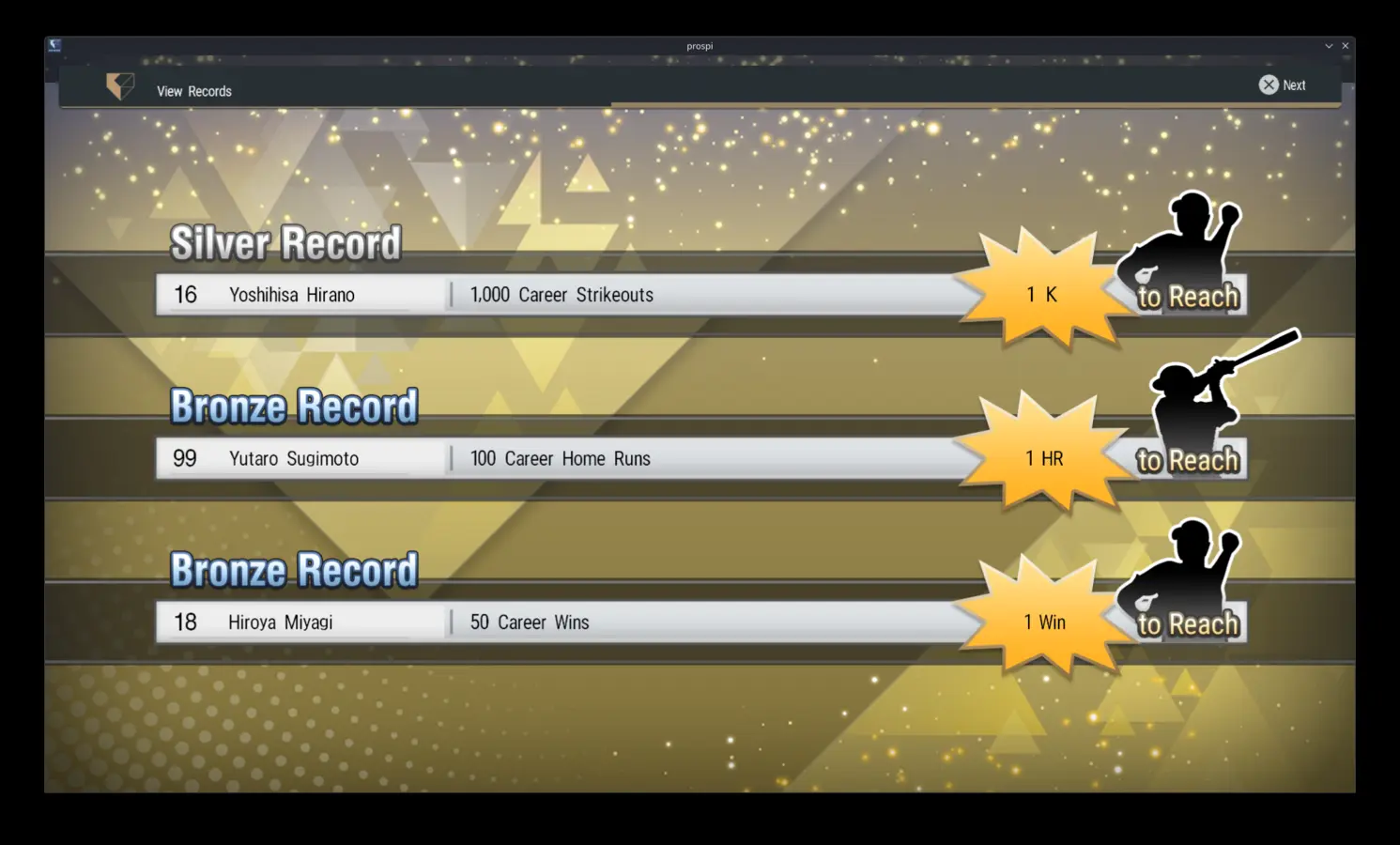
Career-record notices turn individual seasons into a visible history. Use the Archive and milestone screens to remember what the organization has built, not only its current overall ratings.
- Track long careers and franchise icons.
- Keep succession planning separate from sentiment.
Retirements Reveal Real Vacancies
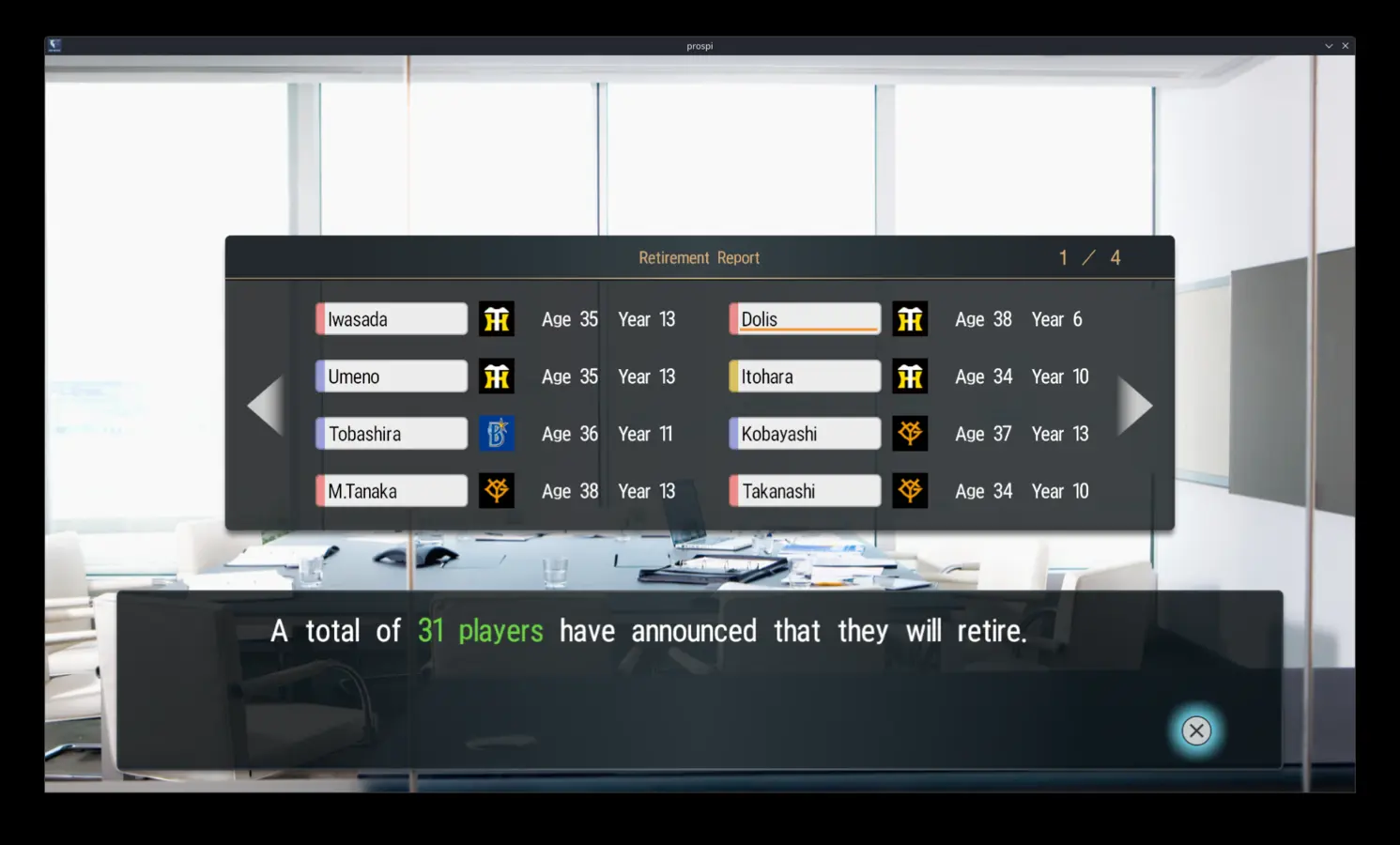
The league-wide retirement report confirms which careers have ended. Only after those departures are known can the next depth chart and staff pipeline be evaluated accurately.
- Replace jobs, not names.
- Check whether a retiring player can enter the staff pipeline.