The Practical Route
- Identify the manager, coach, and scout jobs behind the roster.
- Locate the position group, evaluation need, or pipeline without support.
- Read role attributes, specialties, skills, growth, and conversion.
- Track promising staff and retired-player candidates.
- Change roles only when the complete staff becomes stronger.
Staff Structure
Understand the manager, coaches, and scouts as a second long-term roster behind the players.
Build the Staff in Four Passes
- Set the leadership and tactical foundation.
- Match development and analysis support to the players and roles that matter.
- Cover discovery, examination, regions, and acquisition priorities.
- Prepare future staff before a retirement or vacancy creates an emergency.
Staff Structure: How It Works
Pennant organizations include the Manager, Pitching Coach, Batting Coach, Fielding/Baserunning Coach, Domestic Scout, and International Scout. Each role contributes to a different part of the franchise cycle. Coaches shape development, while scouts shape the information and candidates entering the pipeline. Staff can improve and retired players may continue through coaching and promotion, giving staff decisions their own lifecycle.
Compare the Replacement Before Confirming
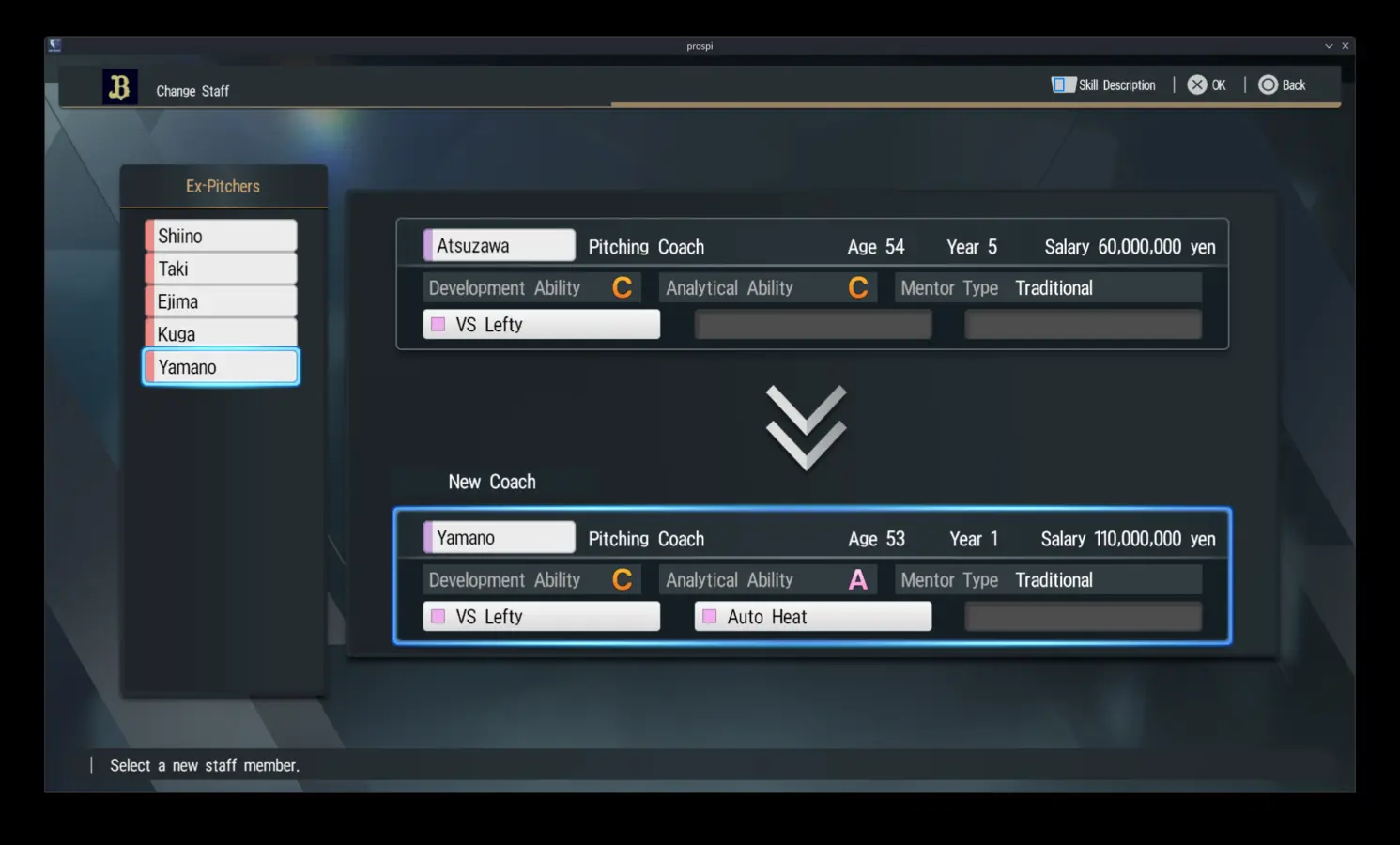
The coach-change screen places the outgoing and incoming staff member in one comparison. Salary matters, but Development Ability, Analysis Ability, specialty, mentor type, and abilities determine the organizational fit.
- Identify the job the coach must improve.
- Compare cost only after comparing fit.
Pennant Staff Positions
| Position | Primary influence |
|---|---|
| Manager | Club-wide skills, drafting, finances, player growth, injuries and awakening |
| Pitching coach | Pitcher training, development compatibility and special training |
| Batting coach | Hitting development and special training |
| Fielding / baserunning coach 1 and 2 | Defense, aptitude, throwing and running development |
| Domestic scout | Domestic draft discovery and examination |
| International scout | Foreign-player discovery and examination |
Why Staff Quality Matters
A coach's development grade changes special-training experience when the coach and player are a good match. S, A and B provide progressively smaller bonuses; C supplies no bonus. Scouts determine how quickly and accurately prospects are discovered and examined.
Coach Attributes and Skills
Evaluate Development Ability, Analysis Ability, and role-specific skills.
Read a Coach in This Order
- Which players and decisions will this coach affect?
- How strongly can the coach support player improvement?
- How well can the coach evaluate information relevant to the role?
- Which positions, attributes, or situations receive additional value?
- Could growth or promotion make this coach more valuable later?
Coach Attributes
Coaches have two distinct core abilities: Development Ability and Analysis Ability. One improves the environment in which players grow; the other improves how clearly the organization can evaluate them. A balanced staff needs both jobs covered.
Development Ability (育成力)
Development Ability supports player improvement. Higher values make the coach more effective in long-term development, and particularly capable coaches may unlock additional training options. Match this strength to the age and needs of the assigned players.
Analysis Ability (分析力)
Analysis Ability improves player evaluation rather than player performance. Better analysis helps the organization judge potential and make clearer roster decisions. Do not replace an evaluator with a development specialist and expect the same result.
Coach Skills at a Glance
| Skill area | What it affects | Why the manager cares |
|---|---|---|
| Player fit | Compatibility between coach specialty and player profile | A suitable coach makes targeted development more efficient. |
| Skill acquisition | The coach can gain or improve staff skills after meeting conditions | Long saves reward retaining and developing useful staff. |
| Manager conversion | Some coach specialties convert into manager skills | A coaching career can shape the manager profile available later. |
Manager Skills
| Skill family | Club effect |
|---|---|
| God's / Golden Right Arm | Improves the chance of winning right-handed draft lotteries |
| God's / Golden Left Arm | Improves the chance of winning left-handed draft lotteries |
| Fundraising / Fundraising ◎ | Increases team funds |
| Appeal / Charisma | Helps attract higher-ability players |
| Coach Development / Coach Cohesion | Improves coach ability growth |
| Foreign Player Awakening / ◎ | Improves awakening chances for eligible foreign players |
| Injury Resistance / ◎ | Reduces injuries |
| Rookie Development / Rookie Elite Education | Strengthens first-year player development |
Coach Specialties
| Coach skill | Best use |
|---|---|
| Young Player Development | Accelerating younger players |
| Veteran Guidance | Supporting veteran development |
| Top Guidance | Training players above 350 overall evaluation |
| Raise Ability | Training players below 250 overall evaluation |
| Strengthen Advantages | Improving a player's established strengths |
| Overcome Weakness | Repairing weak attributes |
| Awakening | Supporting Awakening development |
| Limit Break | Supporting Limit Break development |
Coach-to-Manager Skill Conversion
| Coach specialty | Manager skill gained |
|---|---|
| Young Player Development | Rookie Development |
| Veteran Guidance | Fundraising |
| Top Guidance | Appeal |
| Raise Ability | Golden Right/Left Arm, based on handedness |
| Strengthen Advantages | Fundraising |
| Overcome Weakness | Injury Resistance |
| Awakening | Foreign Player Awakening |
| Limit Break | Coach Development |
Retiring Players Can Become Organizational Staff
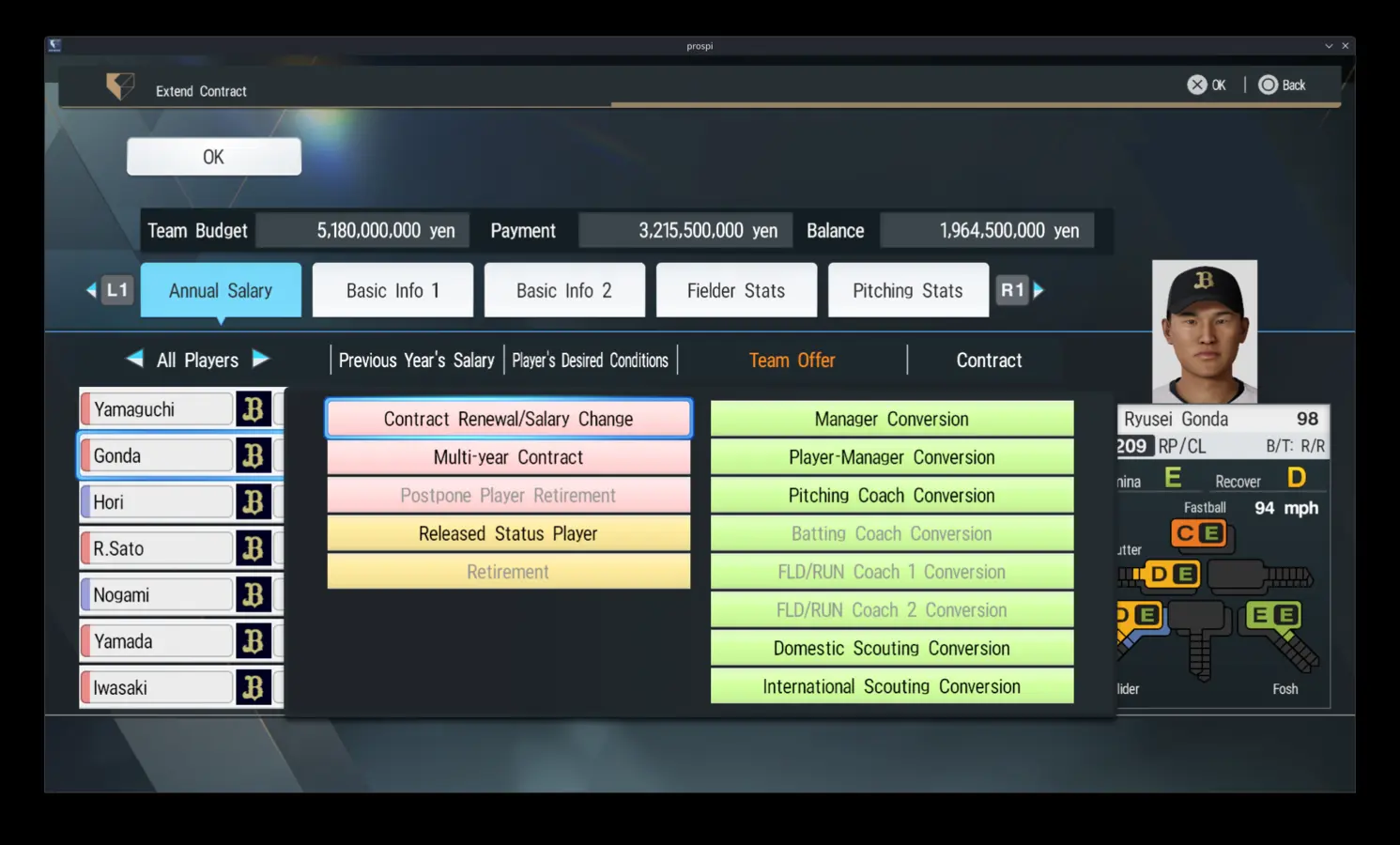
Eligible players may convert into manager, coach, domestic scouting, or international scouting roles. The available actions differ by player, so treat conversion as a succession option rather than a guaranteed destination.
- Check every available conversion before releasing the player.
- Compare the new staff profile with external replacements.
Skill Growth Timing
The legacy guide describes a 20% acquisition check after the listed achievement conditions are met. Staff age 60 or older and staff with more than 15 years of tenure no longer acquire new skills. After four years, several basic manager skills can upgrade to their stronger version; most listed upgrades use a 30% check, while Injury Resistance ◎ uses 10%.
Coach Growth and Promotion
Build staff continuity through development, promotion, and retired-player careers.
The Staff Succession Loop
- Identify strengths, age, growth potential, and weak assignments.
- Keep promising staff in roles where offseason growth can matter.
- Compare the new job’s requirements with the candidate’s converted skills.
- Promote or hire when the complete staff becomes stronger, not merely because a name is familiar.
How Staff Careers Develop
| System | What changes over time | Management implication |
|---|---|---|
| Ability grade | Coaches can improve from C toward B, A, and S when tenure and checks allow | Do not judge a developing coach only by the starting grade. |
| Skills | Achievements and career length can create new staff skills | Long-term staff continuity can produce better specialists. |
| Promotion | Experienced staff can move into larger organizational roles | Track the future manager value of successful coaches. |
| Retirement | Staff careers eventually end | Maintain succession options instead of relying on one staff group forever. |
Offseason Growth
Coach attributes can improve during the offseason, making staff development part of the franchise cycle. Review the staff after each season before replacing someone automatically: a coach who now fits the roster may be more valuable than a new name with a higher single rating.
Coach Ability Growth
| Upgrade | Tenure | Base chance | With Manager: Coach Development | With Manager: Coach Cohesion |
|---|---|---|---|---|
| C → B | 4+ years | 50% | +25% | +50% |
| C → B | 3 years | 25% | +25% | +50% |
| C → B | 2 years | 0% | +25% | +50% |
| B → A | 4+ years | 50% | +25% | +50% |
| B → A | 3 years | 25% | +25% | +50% |
| B → A | 2 years | 0% | +25% | +50% |
| A → S | 4+ years | 20% | — | — |
| B → A (limit break) | 3+ years | 0% | +20% | +50% |
| A → S (limit break) | 3+ years | 0% | +20% | +50% |
Scout Ability Growth
| Upgrade | Tenure | Base chance | Small achievement | Medium | Large |
|---|---|---|---|---|---|
| C → B | 10+ years | 25% | +10% | +25% | +50% |
| C → B | 7–9 years | 12% | +10% | +25% | +50% |
| C → B | 4–6 years | 0% | +10% | +25% | +50% |
| B → A | 10+ years | 25% | +10% | +25% | +50% |
| B → A | 7–9 years | 12% | +10% | +25% | +50% |
| B → A | 4–6 years | 0% | +10% | +25% | +50% |
| A → S | 10+ years | 25% | +10% | +25% | +50% |
| A → S | 7–9 years | 12% | 0% | 0% | 0% |
| A → S | 4–6 years | 0% | 0% | 0% | 0% |
The Repeatable Plan
- Staff quality is a second long-term roster.
- Development and Analysis Ability answer different questions.
- Promotion can change which skills matter.