The Practical Route
- Define the exact starting, relief, platoon, bench, or defensive role.
- Use competition the player can survive well enough to learn from.
- Give enough appearances to evaluate the role.
- Separate ordinary use, Match Experience, and Record Experience.
- Never force a milestone at the cost of workload, health, or winning.
Match Experience and Playing Time
Turn appearances into purposeful development instead of distributing playing time randomly.
Create Meaningful Playing Time
- Starter, rotation turn, relief inning, platoon start, bench appearance, or defensive assignment.
- Use competition the player can survive well enough to learn from.
- One isolated appearance rarely reveals whether the role works.
- Judge the baseball job and the growth effect separately.
Tell Automation How the Player Should Be Used
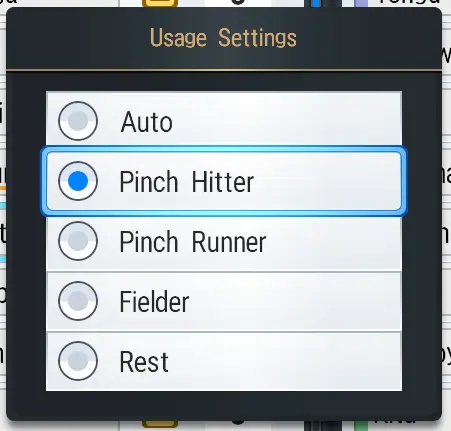
Usage Settings can leave a player on Auto or identify him as a Pinch Hitter, Pinch Runner, Fielder, or Rest option. This turns a vague bench spot into a repeatable opportunity.
- Match the usage label to the development goal.
- Review whether the player is actually receiving the intended appearances.
Match Experience and Playing Time: Overview
Training and Match Experience are separate development routes. Training supplies planned improvement; games supply experience through real participation. A prospect who trains well but never plays can miss part of the development path, while playing time without a clear training direction may produce an incomplete profile. The practical goal is not to force every prospect into the starting lineup. Give important players a role that creates credible appearances and supports the skill set you are building.
Conditions for Match Experience
| Player role | Requirement |
|---|---|
| General | Age 22 or younger, or age 23–25 with overall evaluation 300 or lower |
| Starting pitcher | Pitches at least 5 innings with opponent batting average .050 or lower |
| Relief pitcher | Pitches at least ⅔ inning and allows 0 earned runs, or at least 1⅔ innings and allows no more than 1 earned run |
| Fielder | Records at least one plate appearance |
Record Experience
Understand how meaningful statistical achievements can add development beyond ordinary training and playing time.
How Record Experience Fits the Plan
- The player first needs meaningful opportunities that serve the team.
- A record situation can add value when it naturally fits that role.
- Do not force a milestone at the cost of workload, health, or winning.
- Keep verified achievements separate from incomplete legacy lists.
Performance Can Become Development
Record Experience rewards meaningful statistical achievements. Training improves a player through planned work, while Match Experience comes from participation; Record Experience requires the player to produce a qualifying result. That gives established players and productive prospects another development route. The manager can create the opportunity, but the player still has to earn the result.
Keep the Three Experience Routes Separate
| Route | Primary trigger | Manager influence |
|---|---|---|
| Training | Assigned development work | Choose the focus, staff, and development environment |
| Match Experience | Game participation and usage | Create suitable playing time and roles |
| Record Experience | Qualifying statistical achievement | Create a realistic opportunity, then let performance earn the result |
The Repeatable Plan
- Appearance is not automatically development.
- Repeated purposeful roles produce better evidence than isolated innings.
- Record Experience should reward a real opportunity, not distort the team plan.