Practical Overall Rating Ladder
Use the ladder to create a shortlist. It is a roster-reading aid, not an automatic depth chart.
- Upper boundary or starting marker: 249, 299, 349, 399, 424, 425
Community framework, not an official Konami classification. The final 425 value is a starting marker with no implied upper limit.
Why a Four-Point Overall Difference Is Not the Decision
Use the ladder to create the shortlist, then compare the actual job.
- Player A: 348 overall, natural center fielder, strong range and speed.
- Player B: 352 overall, corner outfielder, more power, weaker center-field fit.
- 1
The ladder places both near the possible-starter boundary. - 2
For a center-field vacancy, position fit, range, speed, abilities, condition, and handedness decide the comparison. - 3
For a pinch-hit vacancy, Player B’s power may matter more.
Illustrative roster example using the community benchmark—not an official Konami classification.
What Each Overall Band Usually Means
| Overall | Practical label | Typical use | What can change the verdict |
|---|---|---|---|
| Below 250 | Development or emergency depth | Farm development, injury cover, low-leverage appearances | Youth, elite speed, one exceptional tool, or a scarce defensive position |
| 250–299 | Specialist, prospect, or lower bench | Pinch-running, platoon work, defensive replacement, mop-up innings | A clearly defined job can make this player more useful than a balanced 300+ reserve |
| 300–349 | Legitimate bench or possible starter | Strong reserve, lower-order regular, back-end starter, usable reliever | Position scarcity, defense, abilities, and team weakness decide whether the player starts |
| 350–399 | Established or strong starter | Everyday lineup, regular rotation, trusted bullpen role | Poor role fit or a major defensive weakness can still make a lower-overall alternative better |
| 400–424 | Star | Core lineup bat, top rotation arm, closer, premium two-way contributor | Condition and matchups still matter; overall does not erase a bad fit |
| 425+ | Superstar marker | Franchise centerpiece or elite specialist | Treat 425 as a practical marker, not a guarantee—inspect the rating profile and abilities |
Takumi's Five-Pass Lineup Build
- Use the rating bands to find realistic candidates, not to choose the winner.
- Decide whether you need run creation, defense, speed, innings, leverage, or a matchup specialist.
- Compare only the attributes that directly affect that job.
- Check special abilities, condition, handedness, role familiarity, age, and development value.
- A good lineup and bench cover each other's weaknesses; they are not simply sorted rating lists.
Start With Every Job, Not Only the Batting Order
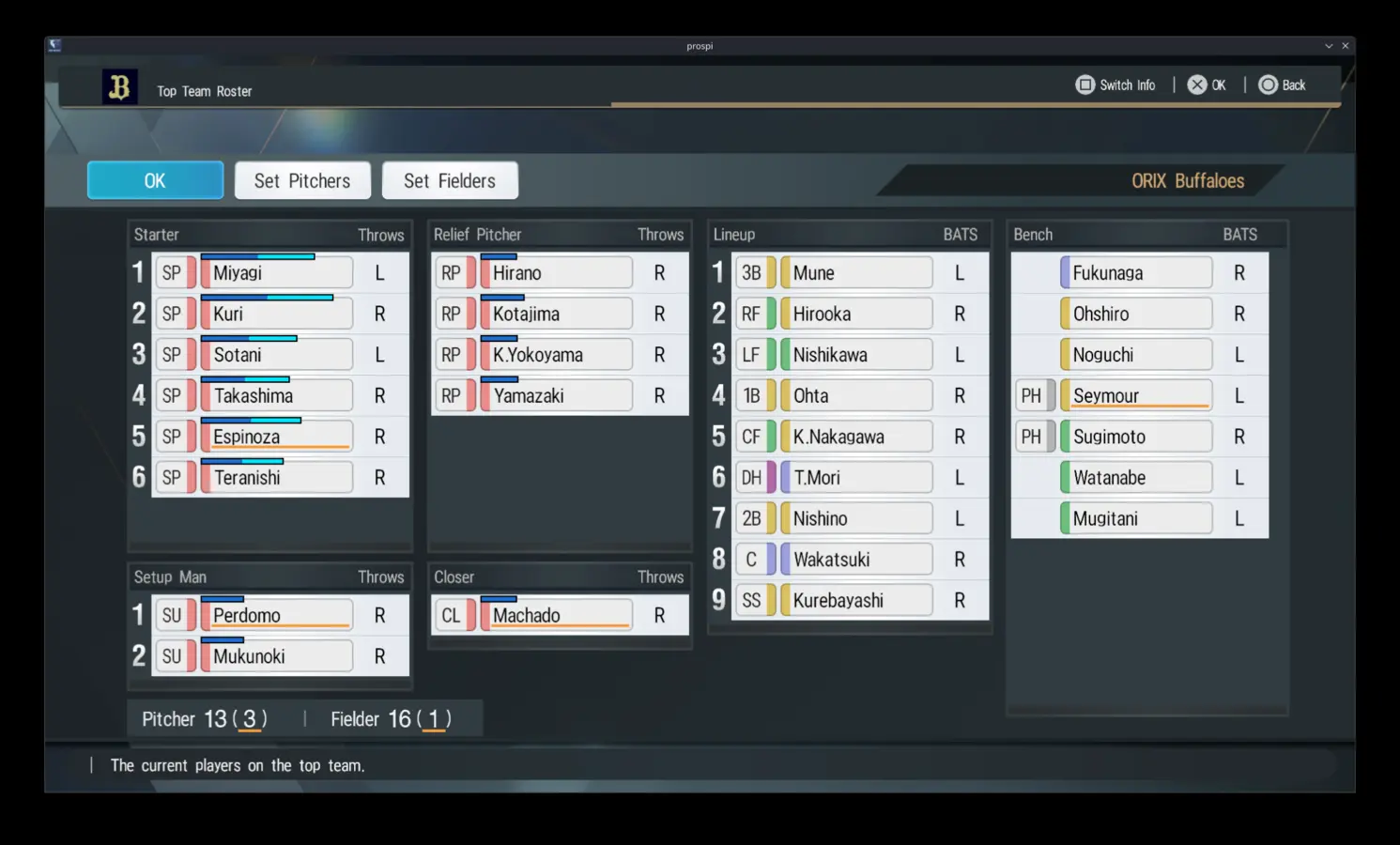
The full roster screen separates the starting lineup, bench, rotation, bullpen, and farm club. A lineup choice can create a bench weakness or remove needed farm playing time.
- Fill the defensive and pitching structure first.
- Give every bench player a job.
- Keep prospects where they can receive meaningful opportunities.
Read Condition, Fatigue, Role, and Rating Together
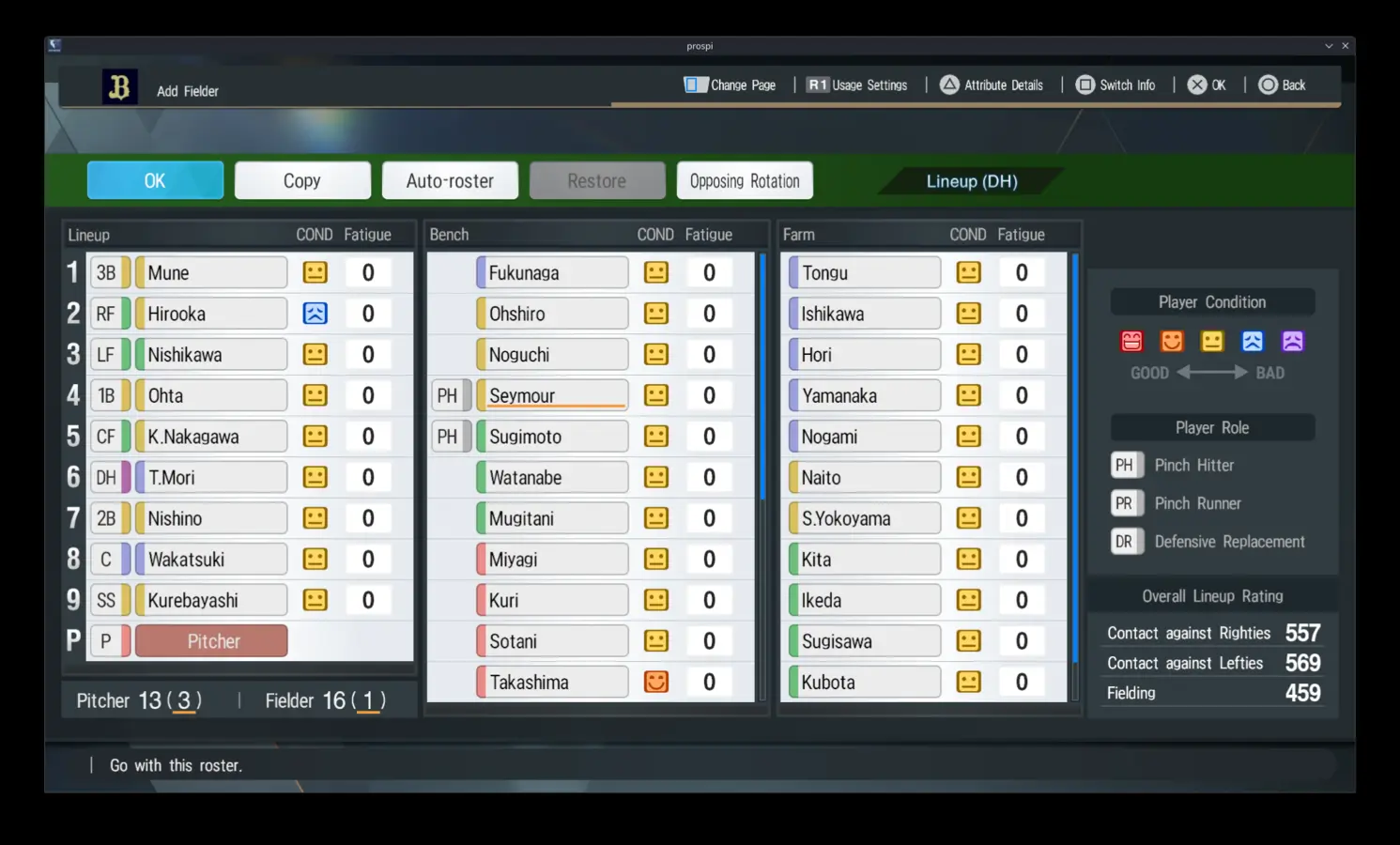
Lineup management shows more than overall ratings. Condition, fatigue, assignment, and player role explain why the ideal healthy order may differ from today’s order.
- Use Best Order as the healthy ideal, not an order that ignores availability.
- After an injured pitcher returns, automatic Best Order behavior can restore the preferred pitching roster according to its update settings.
Best Order and Team Strategy Are Different Layers
Best Order stores the preferred healthy roster and can control automatic updates, timing, top/farm transfers, and transfer policy. Team Strategy controls how that roster plays: roster priority, matchup priority, steals, hit-and-runs, sacrifice bunts, and squeeze plays. Set the roster layer first, then the tactical tendencies.
What to Inspect for Each Job
| Job | Start with | Then check | Do not be fooled by |
|---|---|---|---|
| Leadoff hitter | Contact, speed, baserunning | On-base tendency, stealing, handedness | Speed without enough opportunities to use it |
| Middle-order hitter | Contact, power | Clutch and pitch-type abilities, matchup | A balanced overall that hides ordinary run production |
| Catcher | Catching, throwing, defense | Catcher abilities and pitching-staff fit | A small batting upgrade that weakens run prevention |
| Shortstop / center field | Range, fielding, throwing, speed | Positional aptitude and defensive abilities | Extra offense that cannot repay lost premium defense |
| Starting pitcher | Pitch quality, control, stamina | Velocity, pitch mix, recovery, matchup abilities | A high overall built from ratings that do not sustain innings |
| Reliever / closer | Best pitches, control, velocity | Pressure, recovery, late-game and versus-runner abilities | Starter stamina that contributes little in short appearances |
| Bench specialist | One job-defining strength | Platoon side, speed, defense, bunting or pinch-hit value | A higher overall with no clear late-game purpose |
Use the Lineup Ratings as a Diagnostic
Before first pitch, the lineup screen combines condition, fatigue, defensive affinity, catcher game-calling, and lineup ratings. Use those signals to find the weak job, then inspect the actual player details.
- A rating summary identifies where to look.
- The final choice still depends on matchup, role, and availability.
Build a Bench with Jobs
- Keep at least one reliable defensive replacement for a premium position.
- Carry speed if the starting lineup lacks late-game baserunning pressure.
- Use platoon or pinch-hit value instead of duplicating the same hitter profile.
- Protect positional coverage so one substitution does not force several players out of position.
- Prefer a clearly useful specialist over a slightly higher overall player with no obvious game role.
When Two Players Are Close, Compare Their Jobs
Write the role on top of the comparison. The better starter is the player who solves that role with the fewest compromises—not automatically the player with the larger number.
The Two-Player Tiebreaker
| Question | Player A | Player B | Decision |
|---|---|---|---|
| Who has the higher overall? | Record the number | Record the number | Use this only as the opening comparison |
| Who fits the exact role? | Check role-relevant ratings | Check role-relevant ratings | Prefer the better job fit |
| Who brings harder-to-replace value? | Defense, speed, handedness, ability set | Defense, speed, handedness, ability set | Scarce value can justify the lower overall |
| Who helps now and later? | Condition, age, growth, contract | Condition, age, growth, contract | Separate today's lineup decision from long-term roster value |